

The fastest way to use NotebookLM for AEO is to load the facts you trust, ask it to surface the questions customers actually have, and turn one verified answer into useful website content each week. It is not a magic citation machine. It is a better way to keep your research, customer language, and content drafts tied to real source material.
That is the build I wanted to test: not “Can AI write a blog post?” but “Can I give a business a simple system for creating answers that are actually useful?”
Google describes NotebookLM as a research and thinking partner grounded in the sources you provide. It can work across PDFs, webpages, Google Docs, audio, and more, then show citations back to relevant material in its answers.1 For anyone trying to make content clearer for people and AI search tools, that source-grounded setup matters.
What is AEO, and why should a beginner care?
AEO means Answer Engine Optimization. It is the practical work of making sure your site gives a direct, useful, factual answer when someone asks a real question about your category.
The old mental model was simple: pick a keyword, write a page, hope it ranks, chase the click. The better starting point now is: What question does the buyer have, and is our answer clear enough to deserve trust?
That helps in normal search. It helps a sales rep answer a question consistently. It helps a customer who lands on a product page. And it gives answer engines more useful information to work with.
AEO is not about gaming an answer engine. It is about publishing the clearest verified answer you can give.
Let’s use a fake company so this stays practical
Meet Harbor & Pine Outdoor Gear. It is a completely fictional company that sells insulated water bottles, daypacks, and lightweight hiking accessories.
Harbor & Pine wants to help prospective buyers who are asking questions such as:
- “How long does an insulated water bottle keep water cold?”
- “What size bottle is best for a day hike?”
- “Can I put this bottle in a dishwasher?”
- “What happens if the lid leaks?”
The company does not need an elaborate AI strategy to begin. It needs one NotebookLM notebook built around trusted business information.
| What Harbor & Pine adds | Why it belongs in the notebook |
|---|---|
| Product fact sheet | Gives accurate sizes, materials, care instructions, and warranty details. |
| Existing product-page copy | Shows what the current website already says. |
| Current FAQ | Prevents duplicating answers that already exist. |
| Anonymized support-chat summary | Captures the words real customers use when they are confused, comparing, or ready to buy. |
| Short company overview | Keeps the company description and positioning consistent. |
I would start with five to ten quality sources, not every file in the business. Google’s own beginner guidance makes the same larger point: start with the information you work with, explore the suggested questions, and keep focused notebooks for specific projects.2
How do you create your first NotebookLM notebook?
Open NotebookLM, choose Create notebook, and name it after one focused customer problem. Do not call it “Everything About My Business.”
For this example, the notebook is named:
Harbor & Pine — Insulated Bottle Buyer QuestionsThat name does something important. It gives the work a boundary. This notebook is not for random brainstorming, social posts, annual planning, or every product in the catalog. It is for understanding and answering questions buyers ask before choosing an insulated water bottle.
Before uploading customer data, remove names, email addresses, phone numbers, order details, physical addresses, and payment information. A support-chat summary is usually more useful than raw transcripts anyway. You want the question patterns, not anyone’s private information.
What should you ask NotebookLM first?
Do not start by asking it to “write a blog post.” That skips the useful part.
First, make NotebookLM explain the business back to you. If it cannot accurately summarize the company from the sources you uploaded, it is not ready to draft customer-facing content.
Prompt 1: Check the notebook’s understanding
Using only the sources in this notebook, explain in plain English what Harbor & Pine Outdoor Gear sells, who it serves, and the five facts a first-time customer should know. Cite the source for every factual statement.Read the response and check the citations. If the answer is vague, contradictory, or wrong, fix the sources first. That is not a failure. That is the notebook doing its job: showing you where the business information is incomplete.
Prompt 2: Find the buyer questions hiding in your own data
Using the product information, FAQ, and customer-support sources, list the 20 most important questions a shopper asks before buying an insulated water bottle. Group them into: choosing a product, using a product, shipping and returns, and care instructions.This is where the workflow gets interesting. Keyword tools are useful, but customer messages tell you what people ask when they are actively trying to make a decision. The wording may be messy. That is fine. Messy language is often where the real opportunity is.
Prompt 3: Find the gap before you write
Compare the buyer questions in this notebook with the current product-page copy. Which 10 buyer questions are not clearly answered on the website today? Rank them from highest to lowest purchase intent.Now you have a simple work list. You know what customers want to understand and what the site has not explained clearly enough.
How do you turn one customer question into AEO content?
Pick one question that appears often, matters to a purchase, and can be answered with verified facts.
For Harbor & Pine, the first question is:
“How long does an insulated water bottle keep water cold?”
That question is specific. It is close to a buying decision. And it should have a factual answer in the product documentation.
Use this prompt:
Write an answer-engine-friendly website section for this question:

“How long does an insulated water bottle keep water cold?”

Use only facts from the sources in this notebook. Write:
1. A one-sentence direct answer.
2. Two short supporting paragraphs.
3. A Markdown table showing bottle size, stated cold-retention time, and best use case.
4. A final sentence that tells the reader where to learn more.

Do not invent claims. If a fact is missing from the sources, say what information is missing instead of guessing.
The important phrase is “do not invent claims.” That should be the rule every time. NotebookLM can make a draft faster, but it does not replace product knowledge, legal review, or a human who understands the business.
A strong answer block usually has four parts:
| Part | What it does |
|---|---|
| Direct answer | Answers the question in the first sentence. |
| Supporting detail | Gives the conditions, context, or product facts that make the answer useful. |
| Helpful structure | Uses a short table, list, or comparison to make the details easy to scan. |
| Next step | Sends the reader to a relevant product, guide, or contact path. |
What should a beginner publish first?
I would not begin with a 3,000-word “ultimate guide.” I would start with one answer that makes a buyer’s life easier.
For Harbor & Pine, that could become a short FAQ section on the insulated bottle product page. Six direct questions are enough to create a meaningful first improvement:
- How long does the bottle keep drinks cold?
- What size is best for a day hike?
- Is the bottle dishwasher safe?
- What material is it made from?
- Does it fit a standard car cup holder?
- What happens if the lid leaks or arrives damaged?
Use NotebookLM to prepare the first draft, then verify each answer against the cited source material. If a fact is missing, do not fill the blank with confidence. Get the fact, add it to the source material, and then update the answer.
That loop is what makes the notebook useful over time. Each unanswered question becomes a reason to improve the business’s real documentation.
Can a simple table improve the page?
Yes, when the table helps someone choose. Tables are not an AEO trick. They are a way to organize a decision.
Ask NotebookLM:
Using only the product sources in this notebook, create a Markdown comparison table for Harbor & Pine Outdoor Gear insulated water bottles.

Use these columns:
- Bottle size
- Stated cold-retention time
- Lid type
- Best for
- Care instruction

Only include information that appears in the sources. If information is missing, use “Not specified” rather than guessing.
If the output is useful, add it to a product page or guide. If it reveals missing information, that is useful too. Missing details are often what a buyer needs before they can confidently make a decision.
How do you check whether the work is helping?
Once a week, run a small manual check. Go to the answer engines you care about and search the way a buyer would search. For this fictional company, I would test:
| Query | What to look for |
|---|---|
| “best insulated water bottle for day hiking” | What brands or factors are mentioned? |
| “how long does an insulated water bottle keep water cold” | Is the answer direct, specific, and sourced? |
| “how to clean a stainless steel water bottle” | What content format is being surfaced? |
Keep a tiny audit note. You do not need enterprise software.
| Query | What you found | What to build next |
|---|---|---|
| How long does an insulated water bottle keep water cold? | Competitors provide a direct chart; Harbor & Pine does not. | Add verified retention details and a size comparison table. |
Then bring those notes back to NotebookLM:
I tested these buyer questions in AI search tools. Here are my notes:

[paste notes]

Using the sources in this notebook, tell me which one content gap to solve first, what page or section I should create, and which source-backed facts should be included.
This does not promise that an answer engine will cite you next week. Search results and AI answers are dynamic. But it creates a disciplined habit: find the question, publish the best verified answer, and learn from the result.
A real content-discovery example: Logoclothz
This workflow is the same discovery model I used with Logoclothz. NotebookLM was the source-grounded discovery layer: it organized product facts, existing pages, anonymized customer questions, and content constraints so the team could identify recurring buyer questions and prioritize the clearest pages to improve.
The screenshot below is a supplied analytics snapshot from the three-month period after that content-discovery work began. It reports 107 AI Overview responses (a displayed increase of 82), 27 ChatGPT responses (a displayed increase of 16), 569 organic keywords (a displayed increase of 129), and 2.8K estimated organic traffic (a displayed increase of 1.4K).
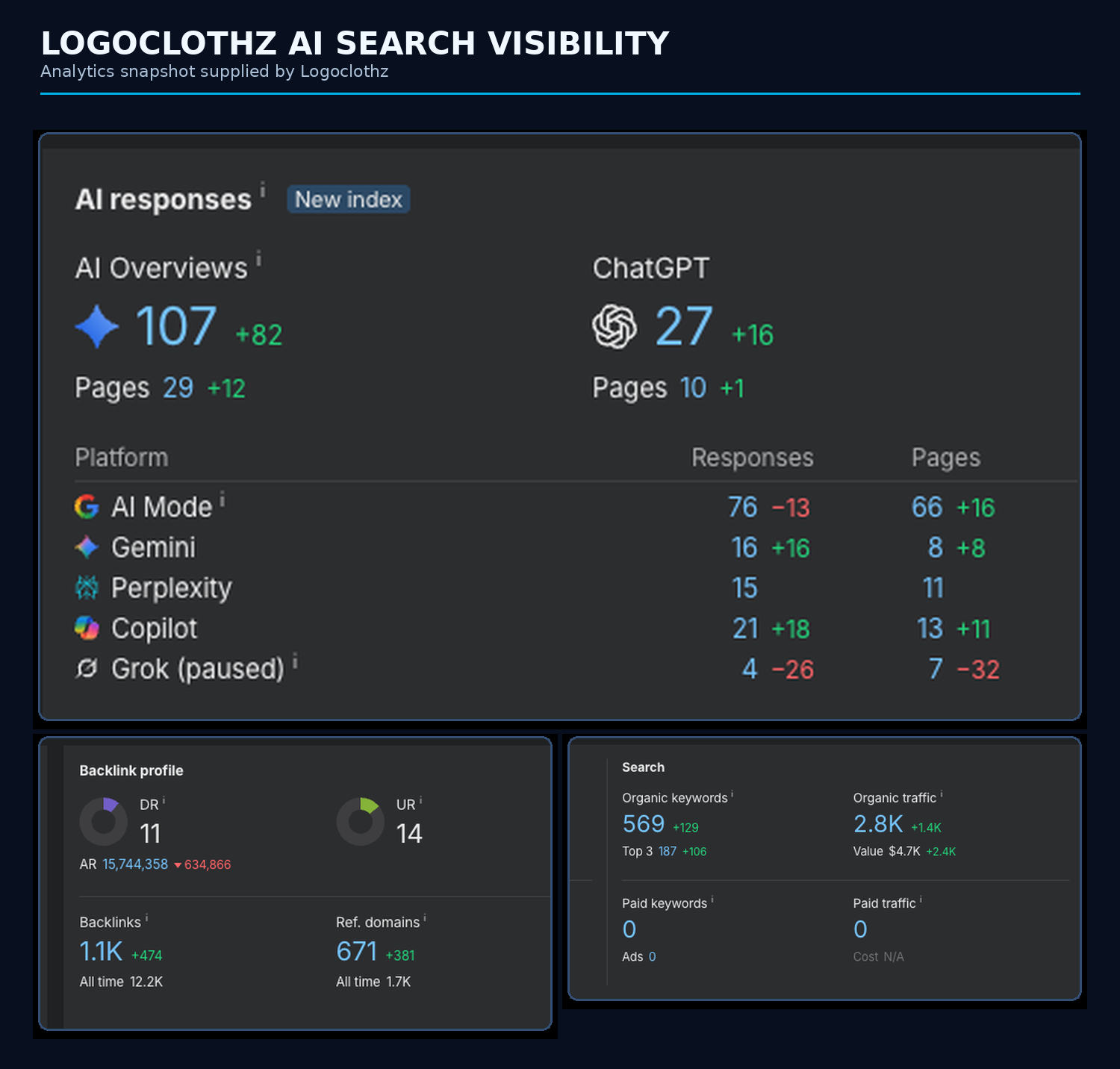
The lesson is not that a notebook creates rankings. It does not. The work that follows matters: verify the source material, answer the buyer question, publish the improvement where it belongs, and monitor what changes. For the earlier implementation and search-performance context, read the Logoclothz SEO 12-Day Checkpoint.
What does a 60-minute weekly NotebookLM habit look like?
The routine does not need to consume your schedule.
| Time | Task | Outcome |
|---|---|---|
| 10 minutes | Add one trusted source or improve an existing source. | The notebook stays current. |
| 10 minutes | Ask for the top unanswered buyer questions. | You choose the next useful topic. |
| 20 minutes | Draft one FAQ or answer block. | You have a source-backed starting draft. |
| 10 minutes | Verify every claim and citation. | You remove unsupported statements. |
| 10 minutes | Publish, schedule, or hand off the finished work. | The content moves from idea to action. |
That is enough. You do not need a massive content calendar before you start. You need one helpful answer published consistently.
What would I avoid doing?
I would avoid uploading sensitive customer data. I would avoid treating an AI draft as approved copy. I would avoid asking NotebookLM to make up missing product claims. And I would avoid chasing every possible keyword before answering the questions existing customers already ask.
The highest-value sources are usually closer than people think: current product facts, clear policies, support questions, sales-call notes, reviews, and honest descriptions of what the company does and does not do.
Why is this better than asking a generic chatbot for a blog post?
Generic chat is useful for brainstorming. NotebookLM is useful when you need the answer tied to a body of information you can inspect.
That difference matters when you are producing customer-facing material. You want a workflow that can point back to the product fact sheet, the customer question, the policy document, or the current website copy. You want to know where an answer came from before you put it on a page with your name on it.
If you are building your own AI knowledge base, the same principle applies: context is an asset only when you can inspect it, improve it, and reuse it. I wrote more about that in Why Your AI Forgets Everything and Stop Using AI to Write Your Blog Posts. Use It for This Instead..
The deeper AEO workflow is the next step: create a structured source of truth, mine real buyer questions, prioritize content gaps, publish clear answers, and monitor what changes. I documented that build in How I Built an AEO Intelligence Stack.
The whole beginner workflow in one sentence
Upload the facts you trust, ask NotebookLM for the questions customers actually have, verify one useful answer, publish it, and repeat next week.
That is not hype. It is a practical way to make your business information more useful to customers and easier for AI systems to understand.
References
Harbor & Pine Outdoor Gear is a fictional example used to make this beginner workflow easy to follow.
Find me across the web


Stay curious, my AI friend. It's the secret sauce - think like you are seven. - Ryan