
LogoClothz generated $2,843.79 in AI-referred tracked revenue during the 90 days ending August 31, 2026, compared with $1,282.69 during the 90 days immediately before that. That is a 121.7% increase in revenue from AI-assistant referrals, alongside a 52.3% increase in AI-referred sessions and a 150% increase in tracked transactions.
The result came after we put a source-grounded AEO NotebookLM stack to work: taking real buyer questions, turning them into answer-first content, correcting entity confusion across the site, and making the store easier for AI systems to interpret and recommend. This is not a victory lap about a magic prompt. It is a transparent, 90-day-before versus 90-day-after report on what changed, how we measured it, and what we still do not know.

What changed across the two 90-day windows?
The baseline window ran from March 5 through June 2, 2026. The comparison window ran from June 3 through August 31, 2026. These are equal-length periods. The July answer-first content release sits inside the second window, which matters when interpreting the result.
| Metric | Prior 90 days | Post 90 days | Change |
|---|---|---|---|
| AI-referred sessions | 348 | 530 | +52.3% |
| AI-referred tracked revenue | $1,282.69 | $2,843.79 | +121.7% |
| AI-referred transactions | 6 | 15 | +150.0% |
| Revenue per AI-referred session | $3.69 | $5.37 | +45.5% |
| AI share of all web orders | 4.4% | 9.0% | 2.0× |
| ChatGPT-attributed revenue | $694.72 | $2,635.56 | +279.4% |
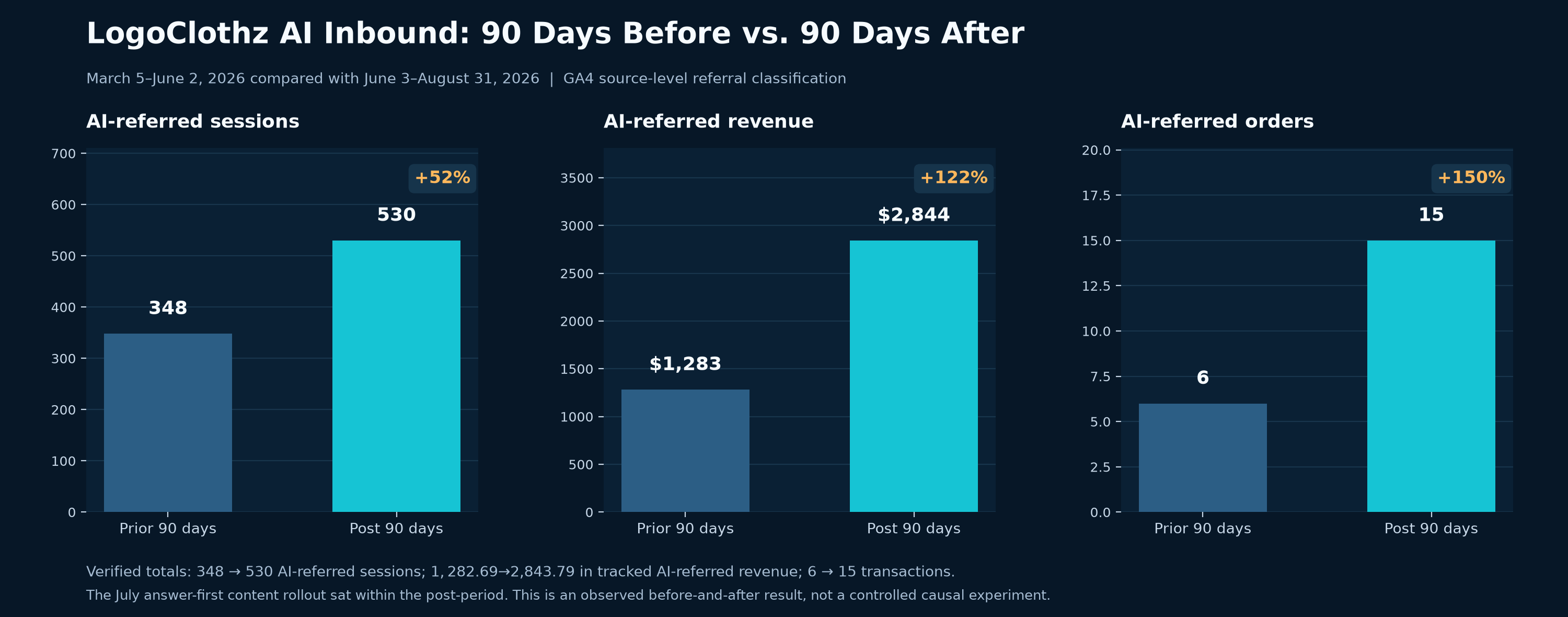
The traffic increase matters. The revenue increase matters more. Revenue per AI-referred session rose from $3.69 to $5.37, which means the outcome was not explained only by a larger audience. The visitors arriving from AI assistants became more commercially valuable in this measurement window.
What did the AEO NotebookLM stack actually do?
The work was built around a simple operating principle: an AI system cannot reliably recommend a business when the business has scattered, inconsistent, or hard-to-cite answers. The goal was not to publish a pile of generic AI content. The goal was to make the most useful commercial facts easy to find, easy to verify, and easy to connect to the right buyer question.
The stack used NotebookLM as a source-grounding layer. We loaded the factual material that could support accurate answers, organized the questions customers actually ask, and used that source base to shape the public content and entity work.
1. We wrote answers before we wrote “content”
In July, LogoClothz published 19 answer-first articles. Each page addressed one buyer question in plain language, with the direct answer near the top of the page. The questions covered practical purchase decisions such as sizing a table cover, understanding pricing, and reviewing return-policy details.
That distinction is important. A page that begins with a useful answer gives a buyer something they can act on and gives an AI assistant something it can accurately summarize. For the underlying process, see my earlier build log on the AEO NotebookLM intelligence stack and the beginner’s NotebookLM AEO workflow.
2. We cleaned the entity instead of treating the store as disconnected pages
The audit found 112 internal-link issues, including 48 links pointing to a staging hostname and 64 links pointing to an abandoned blog subdomain. We corrected those paths, re-hosted nine image assets that depended on the old blog, and consolidated the way the store presents itself as a single coherent source.
This is not glamorous work. It is exactly the kind of work that determines whether a search engine or an AI system can build a reliable picture of a business. When a brand’s facts live across dead hosts, staging URLs, inconsistent pages, and broken media, every new article has to fight that confusion.
3. We made the useful facts citable
The work also added structured data where it belonged, created a proof page around a frequent customer question, and moved internal links to relative URLs so a wrong hostname cannot be carried from page to page again. The outcome is not “more schema” for its own sake. It is a site where a buyer, crawler, or assistant has fewer reasons to doubt what it is reading.
Which AI assistants contributed to the result?
The source-level report included traffic from ChatGPT/OpenAI, Claude, Gemini/Bard, Perplexity, and Copilot. ChatGPT was the largest revenue contributor in the post period, accounting for $2,635.56 in tracked AI-referred revenue and 14 tracked transactions. Gemini added $208.23 and one tracked transaction. Claude and Perplexity also contributed qualified sessions, even where the post-period GA4 revenue attribution was zero.
The point is not that one assistant “won.” The point is that the public information had enough structure and consistency to create inbound paths from several AI environments.
Why did AI inbound convert differently from Google organic?
In the comparison window, AI-referred visitors converted at 2.83%, compared with 1.48% for Google organic. The responsible interpretation is not that AI traffic is universally superior. It is that a well-matched AI referral may arrive later in the decision process.
A buyer who asks an assistant a specific product question can have the basic research handled before the click. If the assistant finds a clear answer on the business’s public site, the referral does not need to land on the article that informed the answer. It can land on the homepage, a category page, or a product page where the commercial decision can continue.
That is the mechanism we are testing:
Answer-first content earns the recommendation. Product and category pages convert the recommendation.
It is also why an AEO strategy cannot be only a blog strategy. The answer pages, entity architecture, product pages, internal links, and checkout experience all have to agree.
How was the report measured?
This comparison uses first-party measurement rather than anecdotal citations or manually observed chatbot answers. The figures were pulled on September 2, 2026 and use the following reporting method.
| Source | What it measured | How it was used |
|---|---|---|
| Google Analytics 4 property 280202349 | Sessions, tracked revenue, and transactions | Referral traffic was classified at the source level for the same AI-assistant domains in both 90-day periods. |
| BigCommerce Orders API | Web-order count cross-check | Used to validate order counts against commerce data. |
| Google Search Console | Article publication and ranking timing | Used to establish the timing of the public content release and search visibility work. |
GA4’s built-in AI Assistant channel group did not exist in the earlier baseline window. To avoid comparing different attribution rules, the report matched the same referral-source families in both periods: ChatGPT/OpenAI, Claude, Gemini/Bard, Perplexity, and Copilot. The GA4 Data API’s runReport endpoint is the reporting interface used to retrieve these dimensions and metrics. 1
What this report does not prove
This is real first-party performance evidence. It is also a small sample: 15 tracked AI-referred transactions in the post period. That makes it useful, not final.
The article rollout was live for roughly six of the thirteen weeks in the post-period. The curve moved after the work went live, but this was not a randomized controlled experiment. Other factors can influence revenue, including seasonality, product mix, promotions, repeat customers, changes in referral tracking, and ordinary business variance.
The report also covers web orders only. It excludes phone orders, which are typically larger, and GA4 can undercount or misattribute some user journeys. That means the correct claim is not “AEO caused every dollar.” The correct claim is that a disciplined, source-grounded AEO rollout coincided with a measurable improvement in AI-referred traffic, revenue, order share, and revenue per session across a like-for-like 90-day comparison.
What we will test in the next 90 days
The next report will use the same source-level definitions and the same 90-day comparison discipline. We will continue publishing answer-first pages around high-intent buyer questions, keep entity and product information clean, and inspect the purchase path where AI referrals actually land.
The question is no longer whether AI assistants can send commercially meaningful traffic. LogoClothz has evidence that they can. The next question is which answer clusters, product categories, and assistant environments create the most durable revenue contribution.
If you want to build this kind of system for your own business, start with the source library—not the prompt. Organize what is true, identify the buyer questions that matter, publish the answers your market needs, and measure the before-and-after change.
Frequently asked questions
What is a 90-day-on-90-day report?
A 90-day-on-90-day report compares one 90-day period with the immediately preceding 90-day period. In this case, it compares March 5–June 2, 2026 with June 3–August 31, 2026. Equal windows make directional changes easier to interpret than comparing partial months or arbitrary date ranges.
Did LogoClothz receive revenue only from ChatGPT?
No. The report includes qualifying referral traffic from ChatGPT/OpenAI, Claude, Gemini/Bard, Perplexity, and Copilot. ChatGPT accounted for the largest share of post-period tracked revenue, while other assistants contributed sessions and, in Gemini’s case, tracked revenue and one transaction.
Why use source-level attribution instead of GA4’s AI Assistant channel group?
The AI Assistant channel group was not available in the baseline period. Source-level classification applied the same rules to both windows, making the comparison more consistent.
Can a small business use NotebookLM for AEO?
Yes, when it is used as a constrained research and source-grounding layer rather than a content vending machine. Start with verified business facts, customer questions, product details, policies, and proof. Then create reviewable answer-first assets that remain accurate when an AI assistant summarizes them.
Is this a promise that AI inbound will grow 122% for every business?
No. The 121.7% increase is LogoClothz’s measured result across these specific windows. A business should treat it as evidence that the method is worth testing, then establish its own baseline, controls, and reporting cadence.
Sources
The performance figures in this article are derived from LogoClothz’s first-party GA4, BigCommerce, and Google Search Console reporting for the stated periods. The $1,282.69 and $2,843.79 revenue totals are shown to two decimal places; rounded display figures may vary by one dollar.
Find me across the web


Stay curious, my AI friend. It's the secret sauce - think like you are seven. - Ryan