
When you start building AI agents, you start small. One skill for blog publishing. One for research. One for social posting. It feels manageable.
Then you blink and you have 51.
The problem is not having 51 skills. The problem is not knowing what you have. Skills with overlapping purposes. Agents calling the wrong skill because the naming is ambiguous. New skills being built that duplicate something that already exists. That is the chaos I cleaned up this week.
Why a Registry Matters
A skill without a registry entry is a skill that will be forgotten or duplicated. When an agent needs to perform a task, it needs to be able to look up the canonical skill for that task. If the registry is incomplete, the agent either guesses or you have to tell it manually every time.
The registry is not documentation for humans. It is routing infrastructure for agents.
Every skill in the registry has four things: a name, a description of what it does, the agent or system it belongs to, and routing notes for cases where it overlaps with another skill. That last part is the one most people skip. It is also the most important.
The Four Categories
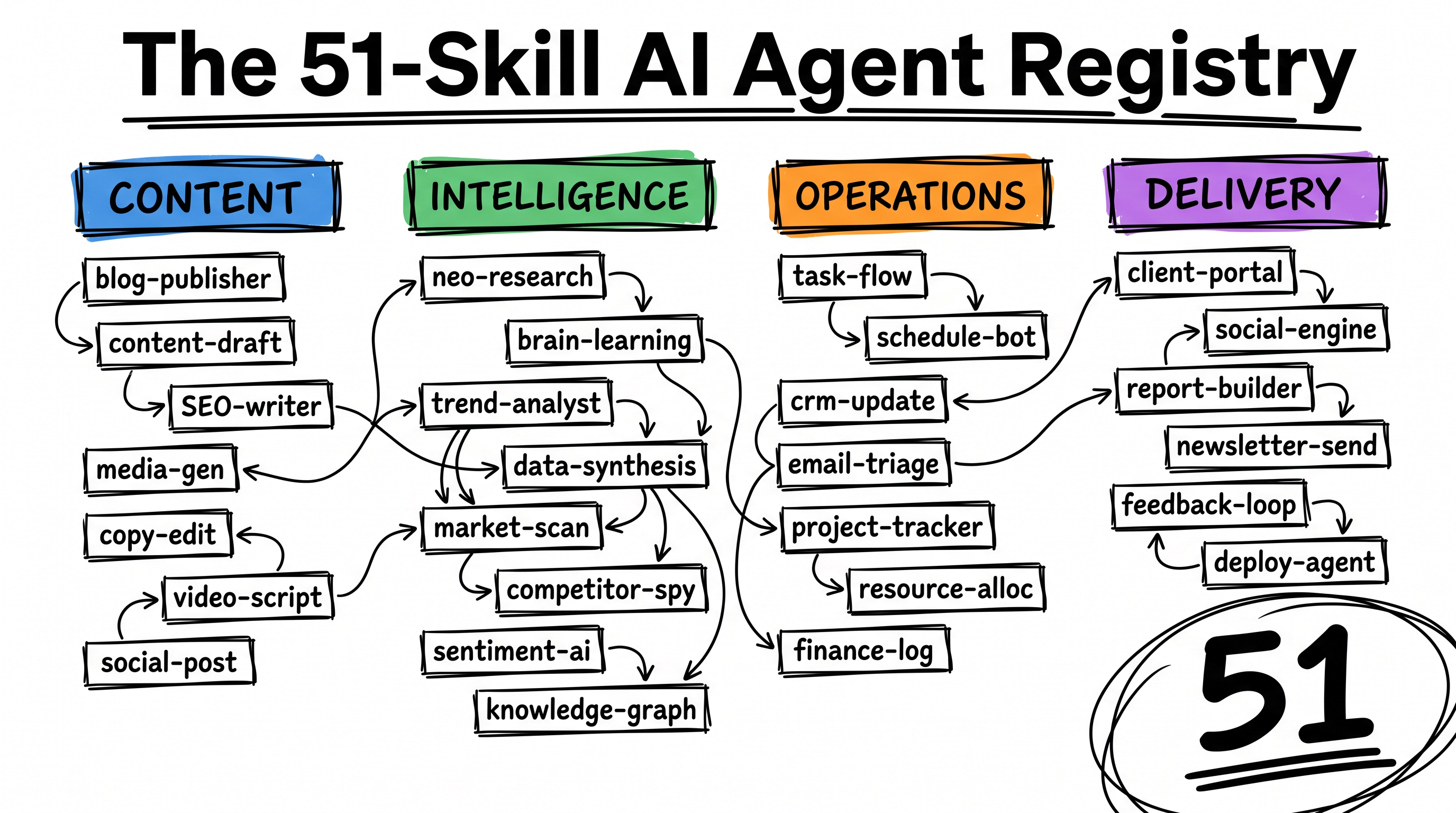
The 51 skills break into four categories:
Content - Everything that produces something a human reads or watches. Blog publishing, content drafting, SEO writing, social posts, video scripts, media generation, copy editing. These skills are the output layer.
Intelligence - Everything that gathers, processes, and scores information. Neo research, brain learning, trend analysis, data synthesis, market scanning, competitor monitoring, sentiment analysis, knowledge graph operations. These skills feed the content layer and the operations layer.
Operations - Everything that keeps the system running. Task flow, scheduling, CRM updates, email triage, project tracking, resource allocation, finance logging. These skills are the connective tissue.
Delivery - Everything that gets the output to the right place. Client portal, social engine, report builder, newsletter sending, feedback loops, deploy agents. These skills are the last mile.
The Audit That Triggered This
The registry cleanup came out of a broader security and hygiene audit. When I went through the full skill list, I found:
Hardcoded API keys in 6 Python files that should have been environment variables. Fixed.
A skill description that defined RPG as “Role-Playing Game” instead of “Ready, Plan, Grow!” Fixed, and all the examples rewritten from gaming industry context to SMB context.
Five planned scripts marked as if they existed when they did not. Marked clearly as NOT IN REPO YET.
A README that listed a builder/ directory that was never created. Removed.
The 51-skill canonical registry replaced a 2-row placeholder that had been sitting there since the early build. Every skill now has a row. That is the rule going forward: if it does not have a registry entry, it does not exist.
The Routing Problem
The hardest part of the registry is not listing the skills. It is handling the overlaps.
There are skills that sound like they do the same thing but serve different purposes. neo-research and market-scan both gather intelligence, but Neo research is ICP-scored and feeds the content pipeline while market-scan is broader competitive monitoring. An agent that picks the wrong one gets the wrong output.
The routing notes in each registry entry handle this. They say explicitly: use this skill when X, use the other skill when Y. It is a few extra lines per entry and it prevents a class of errors that are otherwise invisible until something goes wrong downstream.
What the Registry Enables
With a complete registry, agents can self-route. When a task comes in, the agent checks the registry, finds the canonical skill for that task type, and executes. No guessing. No duplicate work. No me having to explain the stack from scratch every session.
It also makes the stack auditable. I can look at the registry and see exactly what the system is capable of, what is planned but not built, and what might be redundant. That visibility is worth the maintenance overhead.
51 skills is not the ceiling. The registry just means that when skill 52 gets added, it gets added correctly.
Find me across the web


Stay curious, my AI friend. It's the secret sauce - think like you are seven. - Ryan