
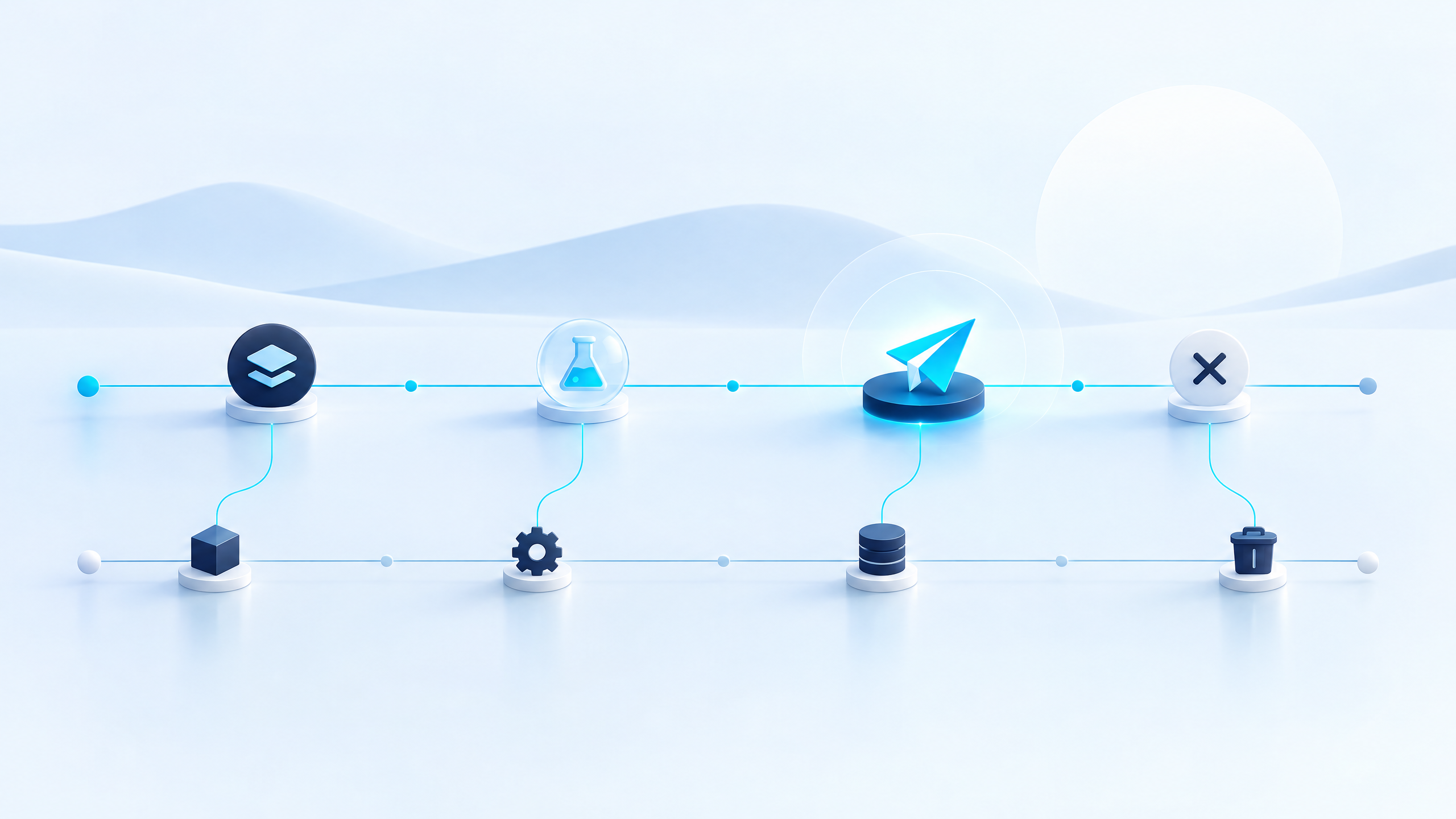
I did not go quiet because nothing was happening. I went quiet to work on the parts of an AI-focused business that are easy to postpone and hard to fake: clearer foundations, deliberate publishing, real-world testing, and the willingness to remove something that did not earn its place.
Editor’s note: This article is part of a retrospective published on October 16, 2026. Its displayed date identifies where the documented work fits in the series timeline.
Not every useful build becomes a customer-facing feature. Sometimes the work that matters most makes the next visible thing easier to understand, review, and undo.
The documented work in this retrospective happened from September 11 through October 16. It included content structure, a more consistent way of describing the site, a feature test, a feature removal, and a more repeatable path for publishing approved changes. The lesson is not that every business needs the same setup. The lesson is that quiet work should still have a clear purpose.
What was happening while I was quiet?
I was tightening the system underneath the public work.
On September 11, I published a build log about basic SEO heading structure and a first-party 90-day AI inbound report. It reinforced that useful content begins with a clear subject and a structure a busy person can scan. Start with the question the page is supposed to answer.
That is why basic SEO heading structure is more than a technical cleanup. Clear headings make the purpose of a page easier for a reader to inspect. They also give a business owner a practical way to maintain the page later, rather than guessing what each section was meant to do.
On September 24, I established a more consistent Ryan identity across shared site information and 17 core pages. In plain English, I wanted the site to stop making people piece together who it represents, what the work is, and how the important pages connect. Consistency is not a promise that a system will reward you. It is a way to reduce avoidable ambiguity.
For a small business, that same idea can be simple: use the same accurate business name, description, offer, and point of view across the pages that matter. A homepage, an about page, a service page, and an educational article should not sound like four unrelated businesses.
Why does quiet foundation work matter?
Because a website is not just a stack of pages. It is a trust system.
A visitor needs to understand what you do, whether the information is current, and what to do next. You need to know where the truth lives when a claim changes or a page needs attention. That is less flashy than launching a new widget, but it is how you avoid building on confusion.
The same is true of ownership. An October 15 website check surfaced a situation where an important visitor path was not as discoverable as it should have been, along with a dependency that made ownership less clear. I wrote about the broader lesson in my website ownership and vendor lock-in check: polished presentation is not the same as a dependable experience.
The practical question is not, “Does my site look finished?” It is, “Can a first-time visitor find the important information without guessing, and do I know who is responsible for fixing it when they cannot?”
Why test a feature and then remove it?
On October 4, I added an AI-video experience and tested it in the live experience. On October 16, I removed it and returned to the prior baseline.
That is not a dramatic failure story. It is a product-judgment lesson.
Too many teams treat launch as the finish line. But effort is not a reason to keep a feature. It should stay because it has a clear place in the experience.
This is especially important with AI. It is easy to add something novel. The harder question is whether it helps the person you are trying to serve, fits the rest of the experience, and can be reviewed with the same care as everything else. When the answer is unclear, removal is often the more responsible choice.
Before you ship a change, ask a blunt question: if this does not earn its place, can we take it out cleanly? That question changes how you test, how you approve, and how tightly you hold onto an idea.
What does it mean to make publishing boring?
It means removing improvisation from an approved change becoming public.
On October 15 and 16, I built and tested a more repeatable publishing pathway. I also tightened publishing access so it matched the job instead of being broader by default. The public lesson is straightforward: routine work should have a routine path.
Boring is not an insult here. Boring means the process is clear enough to follow on an ordinary day and a stressful one. It means someone can check what is intended, publish the prepared result, review what is public, and return to a trusted version if the change needs to come back out.
Start with a one-page checklist: what changed, who reviewed it, what needs checking after it is public, and what the prior trusted version was. The goal is not to eliminate every surprise. It is to stop relying on memory and hope.
What principles sit underneath the work?
The thread running through this month is simple: AI can be a strategic partner, but it should not be an unattended substitute for judgment.
Useful AI work needs source context, clear approval points, and changes that can be explained later. Keep the original material, record why a decision was made, and make room for a person to say, “No, this is not right for the experience.” Capture useful knowledge before rushing to automate it.
Human approval is not a bottleneck by default. It is where responsibility stays visible. Recoverability is not extra process. It is how you keep a reasonable option open when the first choice is not the best one.
What should you do with this in your business?
Run this five-question quiet-work audit before your next visible change:
- What foundation is unclear? Look for mixed descriptions, buried next steps, or pages whose purpose is hard to explain.
- What change needs a real-world test? Decide what you need to observe before calling it a keeper.
- What could be removed safely? Treat a clean exit as part of a responsible plan, not as an admission of defeat.
- Who or what truly needs publishing access? Match access to the job instead of making it broader for convenience.
- Can you explain and reverse the decision later? Record the purpose, the reviewer, and the trusted state you would return to.
If your website or AI workflow feels busy but not dependable, send me the part that is creating friction. We can look at the foundation, the decision points, and the next practical improvement together.
Continue the retrospective Series guide: 30 Days Under the Hood Next: Why Your Website Needs a Clear Machine-Readable Identity
Related reading
- Basic SEO heading structure for a practical page-clarity check.
- Website ownership and vendor lock-in for a closer look at trust, discoverability, and responsibility.
What important work in your business looks unproductive from the outside because it is improving the system underneath, and what foundation or feature decision are you willing to examine before the next visible launch?
Find me across the web


Stay curious, my AI friend. It's the secret sauce - think like you are seven. - Ryan