My AI Brain Isn't a Chatbot.
It is the central nervous system of my entire ecosystem. A structured, retrieval-augmented generation (RAG) pipeline that allows my 14-agent workforce to operate autonomously while staying true to my voice, my experience, and my strategic frameworks.
The Core Philosophy
AI tools are useless without a structured knowledge base. The founder's brain is not scalable. If you want AI to actually do work for you, you have to extract your knowledge, structure it, and make it retrievable. You have to own your context. That is what makes AI powerful.
The Database (Supabase)
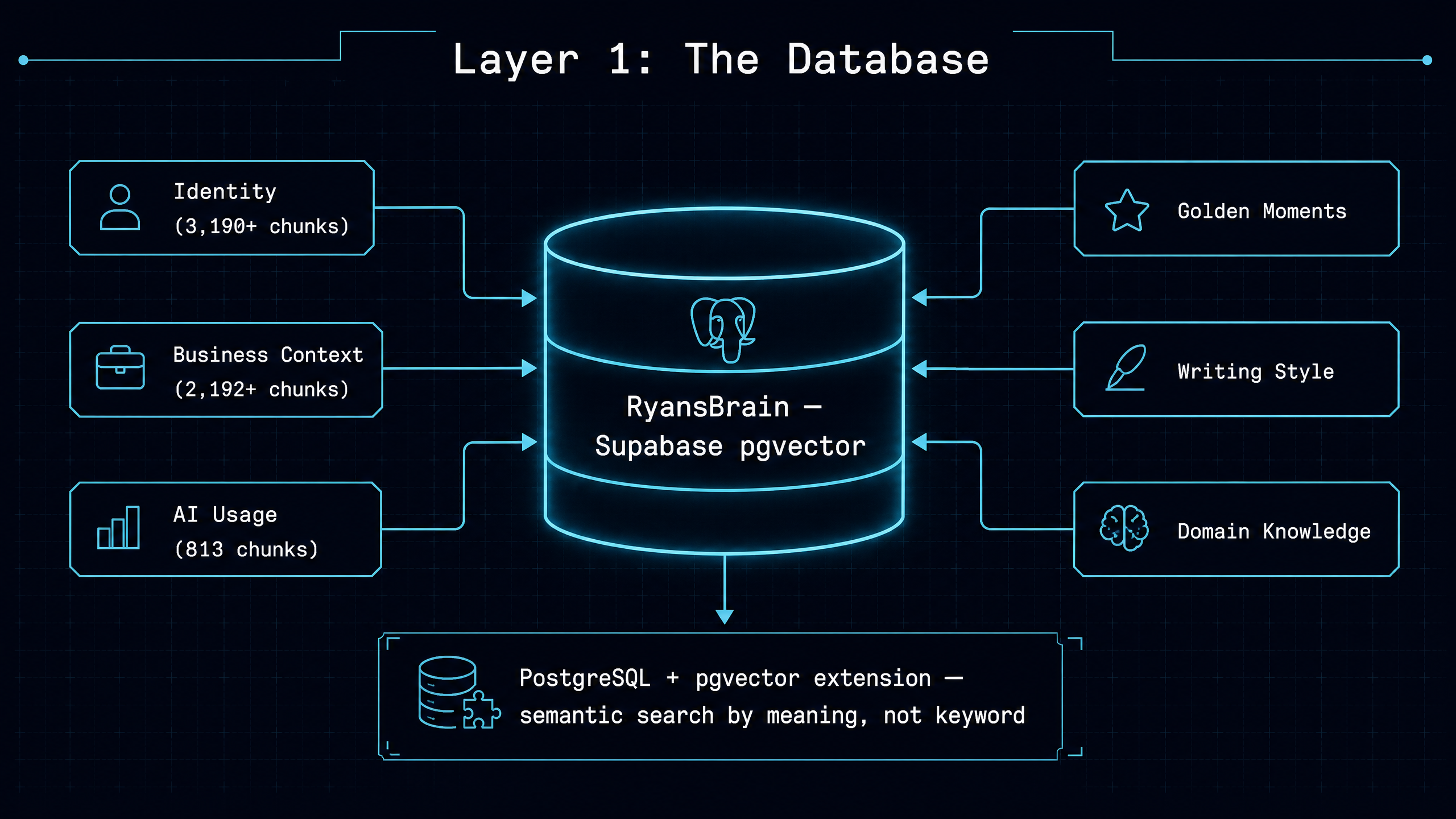
This is where the knowledge actually lives. Not in a prompt, not in a Word doc, but in a vector database. It currently holds over 7,888 chunks of knowledge.
- Platform: Supabase PostgreSQL with the pgvector extension.
- Structure: Every chunk has an ID, category, subcategory, keywords, source, and a confidence score.
- Key Categories: Identity (3,190+ chunks), Business Context (2,192+ chunks), AI Usage, Domain Knowledge, and Golden Moments.
The Capture Layer (Obsidian)
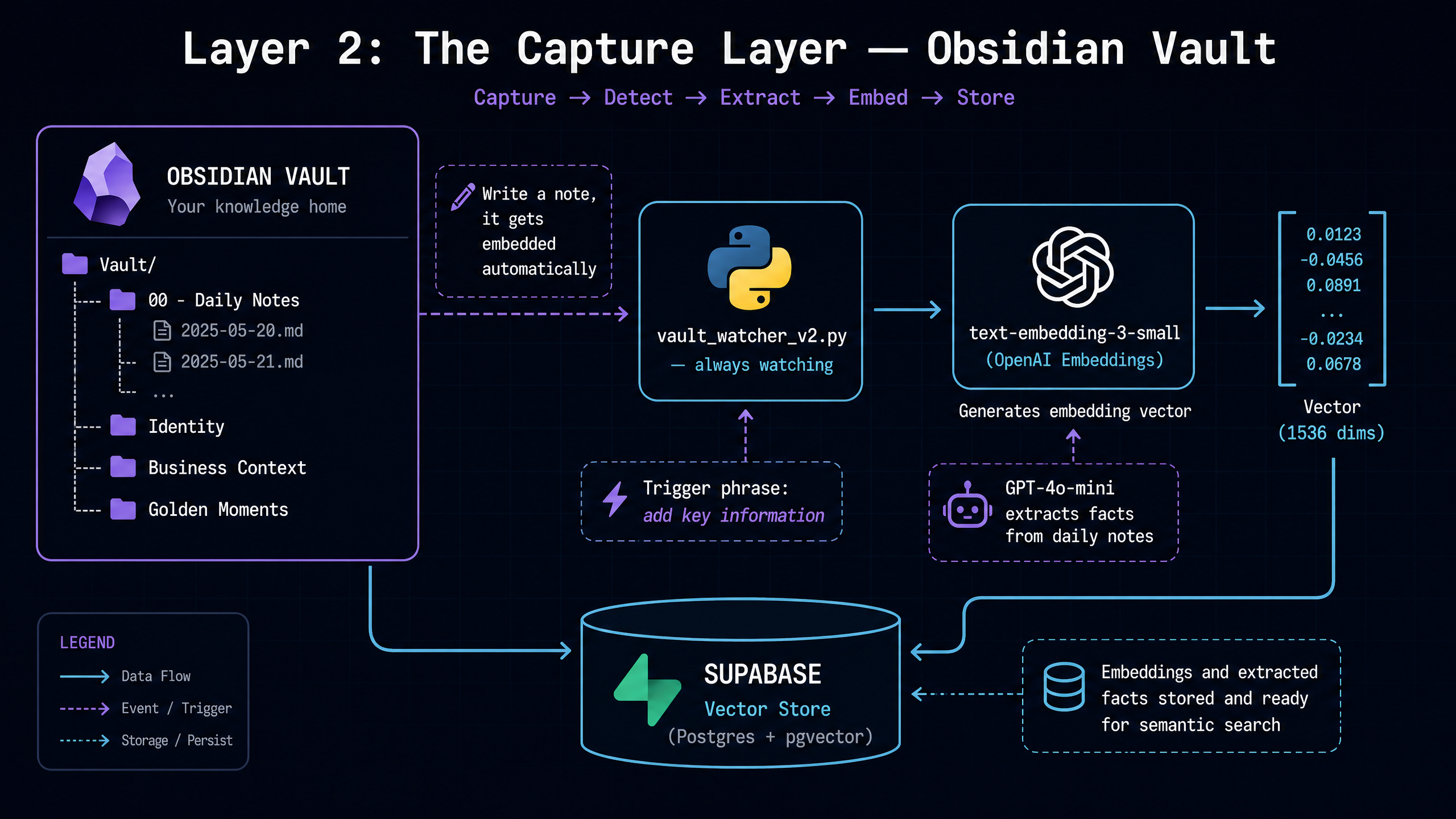
Knowledge has to be easy to capture, or you won't do it. I use Obsidian as my local vault. It's fast, offline, and completely under my control.
- The Automation: A custom script (`vault_watcher_v2.py`) runs in the background, monitoring my vault for changes.
- The Extraction: When I write a daily note, an OpenAI model scans it. If it sees the trigger phrase "add key information," it automatically extracts the facts.
- The Embedding: Those facts are run through OpenAI's `text-embedding-3-small` model, converted into vectors, and pushed to Supabase.
The Interaction Layer (Skills)
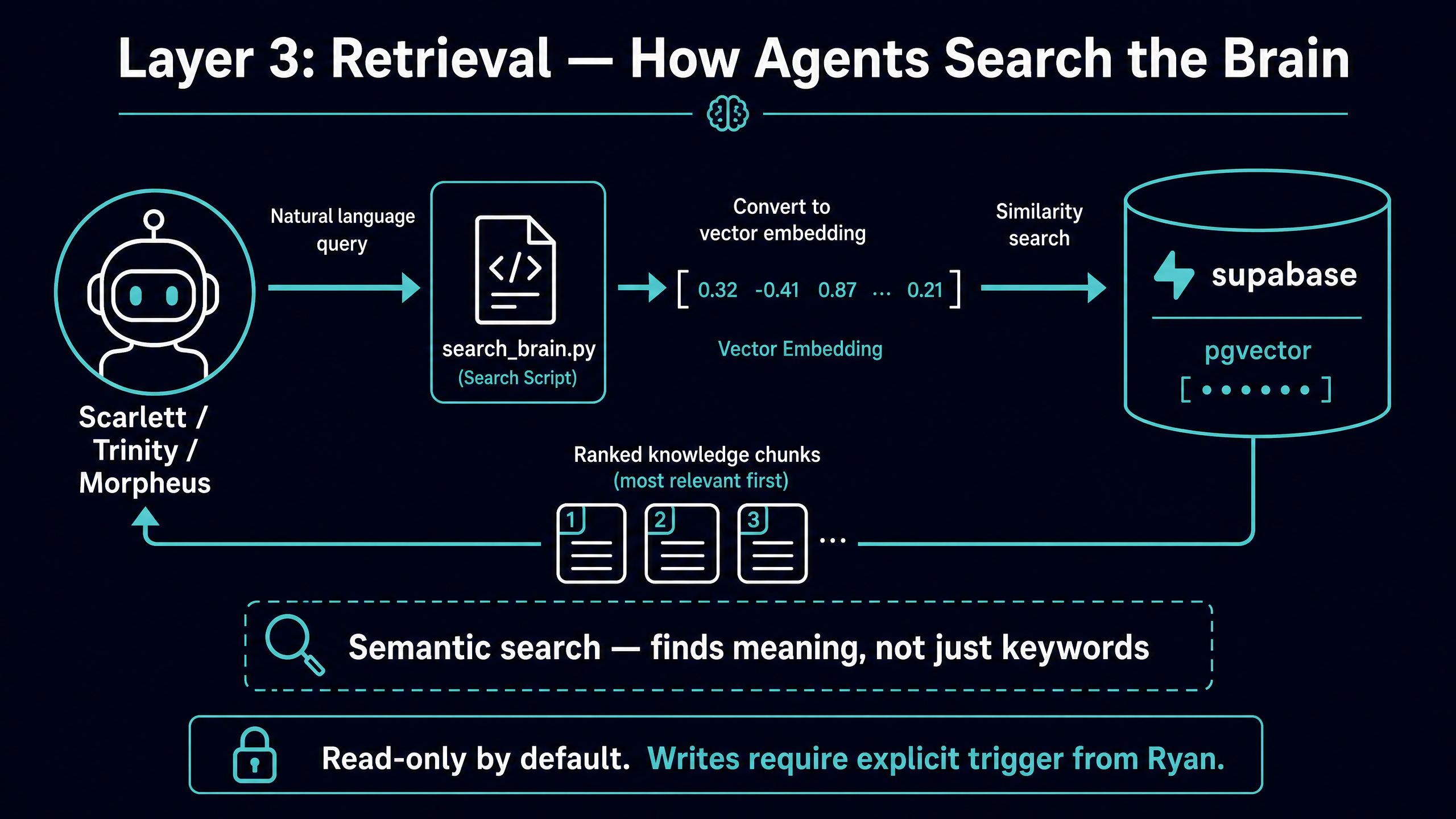
When an agent needs to know something, it doesn't just guess. It uses a custom skill to search the brain.
- The Tool: The `ryan-knowledge` skill acts as the bridge between the agents and the database.
- Semantic Search: It translates natural language queries into vector searches. It finds meaning, not just exact keyword matches.
- Read-Only by Default: Agents can read the brain, but they cannot write to it without an explicit trigger from me.
The Agent Layer
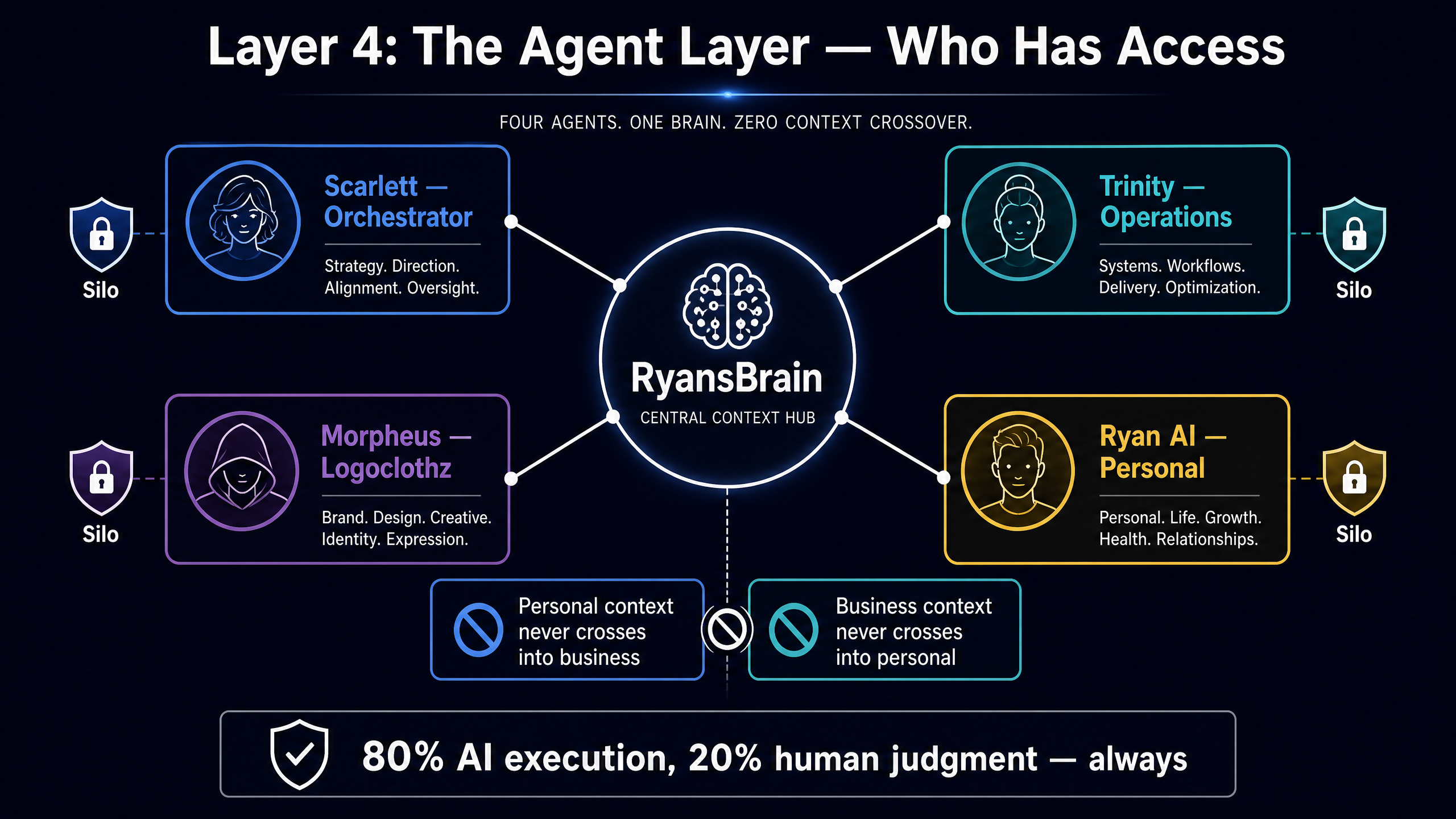
The brain powers the workforce. Scarlett, Trinity, Morpheus, and my personal AI all plug into this central hub.
- Strict Silos: Personal context never crosses into business. Morpheus (Logoclothz) operates entirely separate from the RPG ecosystem.
- Voice DNA: The brain holds my "Voice DNA Profile" - hard rules on how I write (short sentences, direct CTAs, and absolutely no em dashes).
- The 80/20 Rule: The agents do 80% of the heavy lifting. I provide the final 20% of judgment and quality control.
Development Roadmap
This isn't a theoretical concept. It's a live system that I am constantly refining and scaling.
Identity & Infrastructure
Extracted core beliefs via deep-dive interviews. Built the Voice DNA Profile. Deployed Supabase pgvector. Built the Obsidian vault watcher and wired the primary agents (Scarlett, Trinity, Morpheus) to the database.
Knowledge Expansion
Documenting the "Four Pillars of Practical SEO" framework. Building a library of templates. Implementing recursive learning - the system analyzes daily interactions and proposes updates for my approval.
Ecosystem Growth
Fully transitioning weekly content generation to Trinity using "Golden Moments." Developing interactive AI-administered assessments. Replicating this exact Portable Brain architecture for RPG clients.
Ready to build your own Portable Brain?
Stop renting generic chatbots. Start building a knowledge moat that actually understands your business, your voice, and your operations. The best place to start is organizing your knowledge.