The Logoclothz Knowledge Base
Isn't Just a Database. It Learns.
Most AI systems only add knowledge. This one also knows what to forget. The Logoclothz KB is a living, recursive intelligence layer - it ingests data every night, validates it, and prunes what no longer serves the brand. Here's exactly how it works.
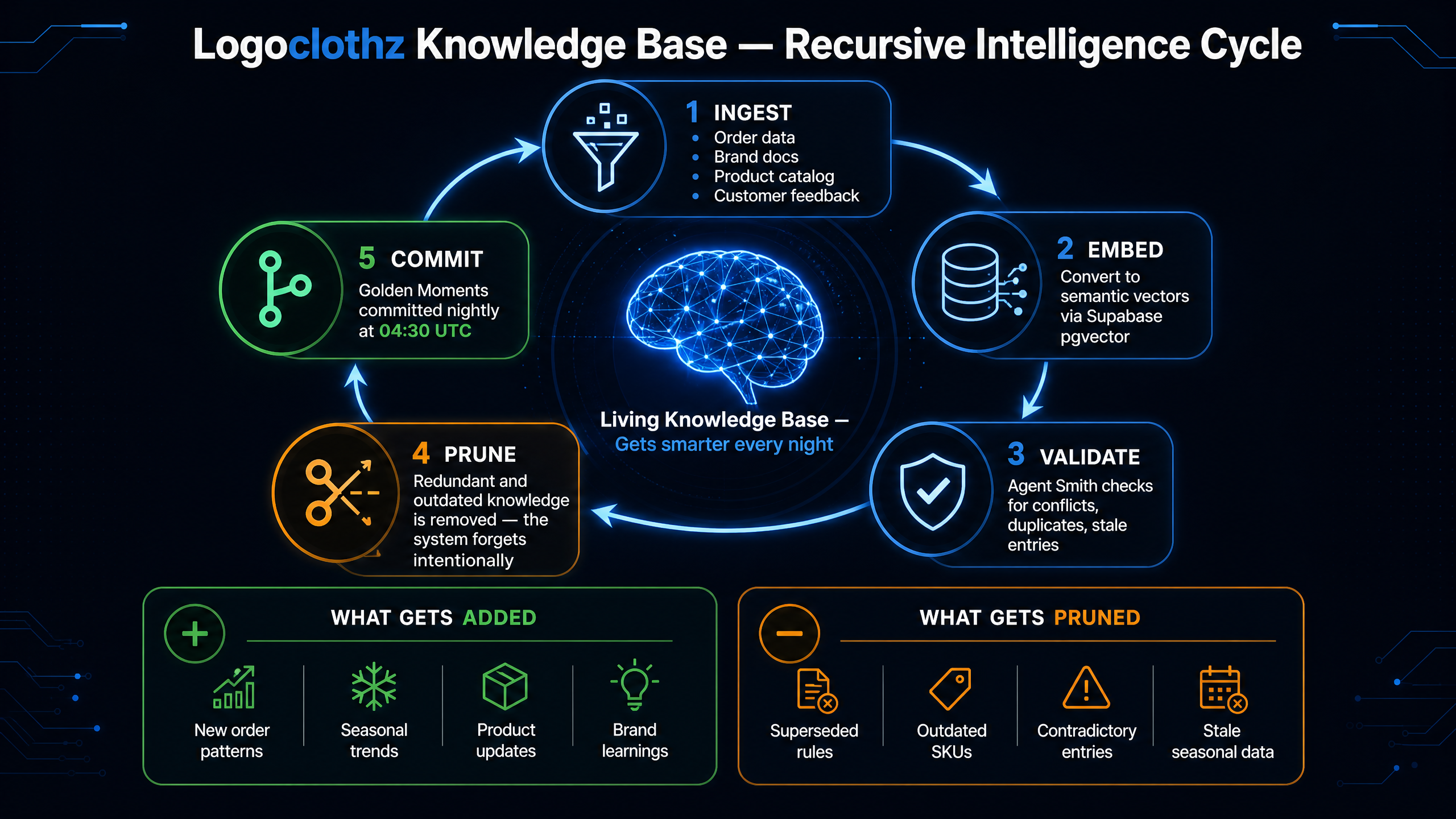
The 5-stage recursive cycle that runs nightly at 04:30 UTC
What happens every night at 04:30 UTC
Ingest
Raw inputs flow in from four sources: order data (transaction history, SKUs, customer patterns), brand documents (guidelines, playbooks, policies), product catalog updates, and customer feedback signals. Nothing is assumed - every input is timestamped and sourced.
Embed
Each document is chunked semantically - not by character count, but by meaning. Chunks are converted to vector embeddings via Supabase pgvector. This is what makes the system searchable by intent, not just keyword. A query about "holiday shipping delays" will surface relevant order history even if those exact words never appear together.
Validate
Agent Smith - the monitoring agent in the Logoclothz Matrix - runs a conflict check before anything is committed. It looks for contradictions (two brand rules that say opposite things), duplicates (the same knowledge stored twice with different wording), and stale entries (data that references products, prices, or policies that no longer exist). Anything flagged is held for review.
Prune
This is what makes the system different. Most AI knowledge bases only grow - they accumulate noise over time until the signal gets buried. The Logoclothz KB actively removes knowledge that no longer serves the brand: superseded rules, discontinued SKUs, contradictory entries, and seasonal data past its relevance window. The system is designed to forget intentionally.
Commit
Validated, pruned knowledge is committed as Golden Moments - structured markdown files that capture the most valuable learnings from each cycle. These are the source of truth for every agent in the Logoclothz Matrix. Ghost reads them before writing. Neo reads them before researching. Morpheus reads them before reporting.
Not everything that comes in stays in
What Gets Added
- New order patterns and customer behavior signals
- Seasonal trends and demand forecasts
- Product catalog updates and new SKU attributes
- Brand learnings from content performance
- Agent observations and Golden Moments
What Gets Pruned
- Superseded brand rules replaced by newer versions
- Discontinued SKUs and archived product lines
- Contradictory entries that would confuse agents
- Stale seasonal data past its relevance window
- Duplicate knowledge stored with different wording
A knowledge base that forgets is more powerful than one that doesn't
Every AI system I've built has taught me the same lesson: garbage in, garbage out - but the garbage accumulates silently. You add knowledge for six months and then wonder why your agents are giving inconsistent answers. The answer is almost always that the KB has contradictions baked in that nobody cleaned up.
The prune stage isn't a nice-to-have. It's what keeps the system trustworthy at scale. When Ghost writes a product description, it's reading from a knowledge base that has been validated, deduplicated, and pruned within the last 24 hours. That's the difference between an AI that sounds like it knows the brand and one that actually does.
This is the system I built for Logoclothz. It runs every night. It gets smarter every cycle. And it's the foundation that every other agent in the matrix depends on.
Want to build a system like this for your business?
I teach this inside Ready, Plan, Grow! - the community I run with Marcela where we help small business owners and builders implement real AI systems without vendor lock-in. $50/month. No fluff.
Join Ready, Plan, Grow! →