
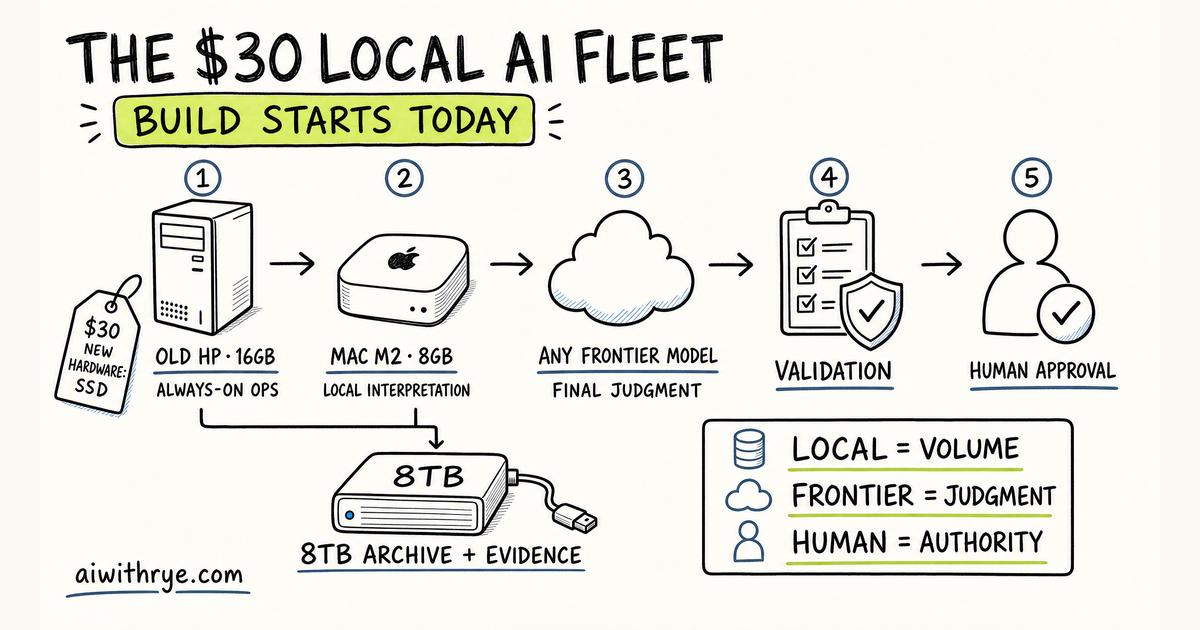
A useful local AI fleet does not require a rack of expensive hardware. Starting today, I am building one with a Mac M2, a 12-year-old HP desktop, an 8TB archive drive, and whichever frontier model in my ecosystem best fits the final judgment task. The point of this build is not to prove that old hardware is powerful. It is to prove that clear division of labor matters more than putting every task on the most expensive model.
A lot of the local AI fleet posts I see start with $10,000 Mac Studios or DGX-class hardware. That is interesting, but it is not where most founders or small-business owners can start.
I am starting with machines I already own and about $30 in new hardware.
What am I building?
I am building a small, private AI fleet for continuous research, website monitoring, catalog review, evidence gathering, and daily decision support. This is the next layer beneath the read-only worker runtime I already built.
The build begins today. What follows is the plan, not a victory lap.
| Component | Planned role |
|---|---|
| Mac M2 with 8GB RAM | Interpretation tier running a small, quantized local model |
| 2014 HP desktop with 16GB RAM | Always-on queue, monitoring, indexing, and deterministic workers |
| 8TB drive | Archive for outputs, logs, evidence, and recovery artifacts |
| Any frontier model in my ecosystem | Final judgment on distilled findings, selected according to the job |
The only new purchase is an SSD for the old HP, at roughly $30. Electricity and real throughput will be measured as the system runs rather than treated as settled facts on day one.
Why does architecture matter more than hardware?
A small local model is not where I want to place high-stakes judgment. It is where I want volume.
The local model will read, summarize, classify, tag, compare today’s data with yesterday’s data, and flag what changed. It will process repetitive work without sending every raw item to a paid cloud model.
Then a frontier model in my ecosystem will receive a distilled digest and handle the narrower judgment task. The specific model can change according to capability, cost, availability, and the job itself. The architecture is not tied to one AI provider.
This follows the same principle behind my broader multi-agent orchestration approach: one general-purpose model should not own every responsibility.
The local model handles volume. A frontier model judges the residue. A human authorizes consequential action.
Unlimited local inference does not automatically improve every result. It makes continuous, low-cost observation possible.
What job will each machine own?
The old HP desktop will become the always-on appliance. It will own the job queue, run deterministic workers, build a searchable index, monitor failures, and preserve evidence. None of that requires a cutting-edge processor. It requires a stable machine that can stay on and recover cleanly.
The Mac M2 will be the interpretation tier. It will pull structured jobs from the queue, run them through a small local model, write validated results back, and idle when no work is waiting. Because this is asynchronous work, it does not need real-time chatbot speed.
The archive drive will retain outputs, logs, model responses, validation results, and versioned artifacts. If I cannot explain what happened or reconstruct a decision, the system is not ready.
The frontier-model tier will never be a hardcoded dependency on one vendor. Any approved frontier model in my ecosystem can be selected for the final reasoning step.
What software will connect the fleet?
The first version is intentionally boring:
- Ubuntu Server on the old HP for a stable, headless operating system.
- Tailscale for a private network between machines.
- Ollama for serving the local model.
- SQLite for the first job queue and state store.
- Cron for simple scheduling while the workflow is still small and observable.
I am not beginning with Kubernetes, a complex message broker, or a dashboard full of moving parts. I will add complexity only when a measured limitation earns it.
How will I keep the system safe?
Small models can return confident answers that are wrong. That means model output cannot be trusted simply because it is structured.
Every local-model result will pass through deterministic validation before it moves downstream. Invalid or uncertain results will enter a review queue. Workers will begin read-only. They can gather evidence and produce findings, but they cannot publish, email, purchase, delete, or modify production systems.
This is the same human-in-the-loop rule I use across my AI systems: completed work is evidence for a decision, not automatic permission to act.
The control path is simple:
- Deterministic workers gather evidence.
- The local model reads and structures that evidence at volume.
- A frontier model in the ecosystem reviews only the distilled residue.
- Deterministic checks validate the output.
- A human approves anything consequential.
What will the fleet do first?
The initial use cases are narrow enough to measure:
| First workload | Expected output |
|---|---|
| Hourly website quality checks | Only new or worsened issues, with evidence |
| Competitor page monitoring | Changes compared with the prior snapshot |
| Catalog audits | Drafted corrections waiting for review |
| Research scoring | Scores tied to quoted evidence |
| Daily intelligence digest | Distilled findings for frontier-model review and human approval |
I will document the build as it progresses, including what fails, what the old hardware can actually sustain, which local models are useful, and where the architecture needs to change.
What will make this build successful?
Success is not a benchmark screenshot. It is a system that can run continuously, recover after failure, show its evidence, control its costs, and keep humans responsible for important decisions.
The fleet is not the flex. The division of labor is.
Frequently asked questions
Can old hardware run a useful local AI fleet?
Yes. Older hardware can manage queues, monitoring, indexing, and deterministic workers, while a newer but modest machine runs a small local model. The key is assigning each machine work that fits its capabilities.
How can a local AI fleet reduce cloud-model costs?
The local tier handles repetitive reading, classification, tagging, comparison, and summarization. A frontier model in the ecosystem receives only the distilled findings that require stronger judgment.
How do you make a small-model AI system safer?
Use deterministic validation, read-only workers, explicit review queues, and human approval for consequential actions. A model finding is evidence for a decision, not permission to act.
What software is planned for this local AI fleet?
The initial plan uses Ubuntu Server, Tailscale, Ollama, SQLite, and cron. Each component has one narrow responsibility, which keeps the system understandable and easier to recover.
Related reading:
- Why I Built a Read-Only Worker Runtime for My AI
- Multi-Agent Orchestration Basics
- Where I Put the Human in Every AI System I Build
What is the oldest piece of hardware you would trust with one narrow job in an AI system?
Find me across the web


Stay curious, my AI friend. It's the secret sauce - think like you are seven. - Ryan